
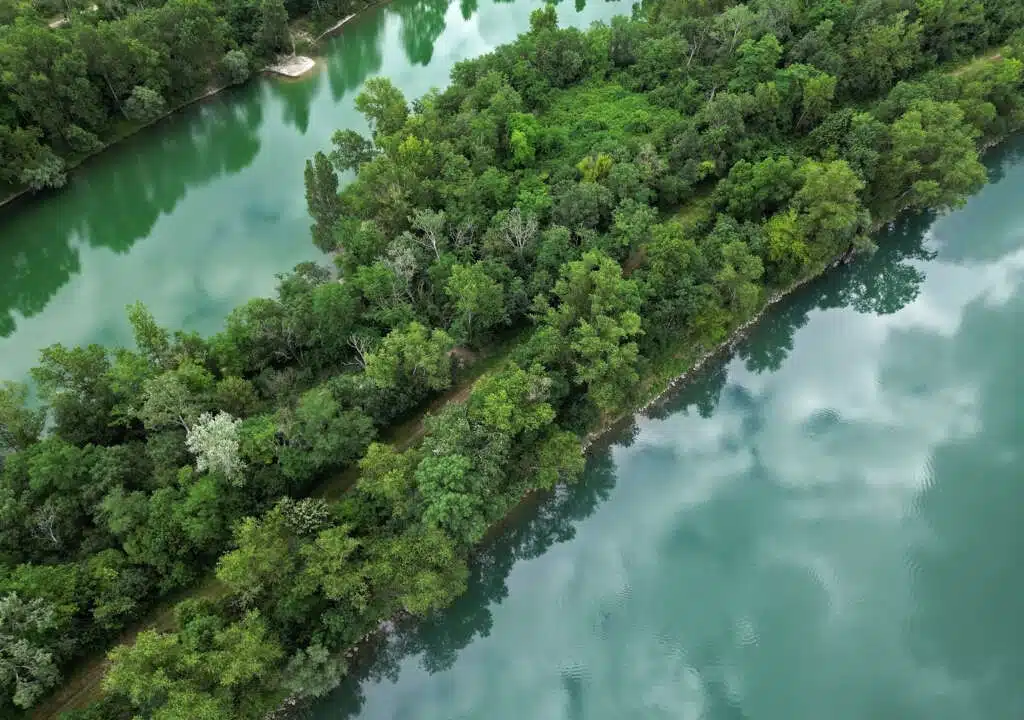
A river modelled by its natural processes
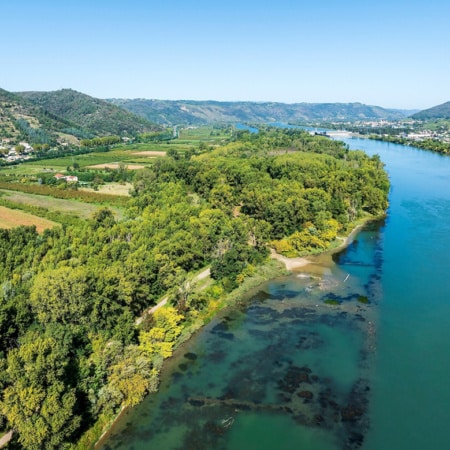
The Rhone is a powerful river whose good ecological health relies on the circulation of sediments, the action of floods and the presence of oxbows and alluvial forests. These mechanisms generate a mosaic of habitats favourable for animal and plant species.
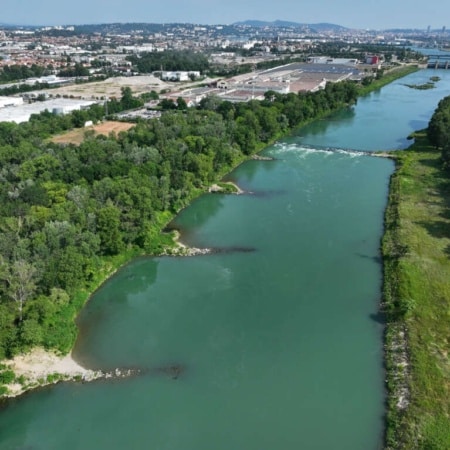
The works and dikes erected at the end of the 19th century to facilitate river transport participated in “corseting” the river, and combined with the hydroelectric developments built in the second half of the 20th century, progressively degraded and uniformised the habitats composing it, negatively impacting biodiversity.
The ecological restoration programme carried out by CNR is aimed at returning space to the Rhone, reconnecting the main channel of the river to its associated wetlands and favouring natural erosion processes that sustain biodiversity.
It is fully integrated in the European Framework Directive on Water which pursues several objectives to reach a good ecological state of water bodies.
The results are there to see: the scientific monitoring project RhônEco has already shown the diversification of habitats and the return of the river’s characteristic animal species such as the grayling, pike, barbel, beaver and kingfisher.
These actions are completed by the ecological management of the banks: “zero phytosanitary products”, selective mowing, the combat against invasive species.
Furthermore, local consultation is aimed at ensuring implementation in phase with the uses and expectations of the territories.
CNR’s ecological restoration programme is:
- 120 km of river restored since 1998, i.e. nearly 1/4 of the French Rhone, between increasing discharges and relinking oxbows;
- More than €100 million invested since 2000 with considerable aid from theAgence de l’eau Rhône Méditerranée Corse
- Old structures demolished to give the river back its space;
- Thousands of m3 of sediments put in movement to regenerate natural habitats;
- Secondary branches reopened or created,
- Recreation of wetlands and spawning grounds;
- Continuous scientific monitoring
- (RhônEco et OSR – Observatoire des Sédiments du Rhône)
- Consultation with the territories and users.
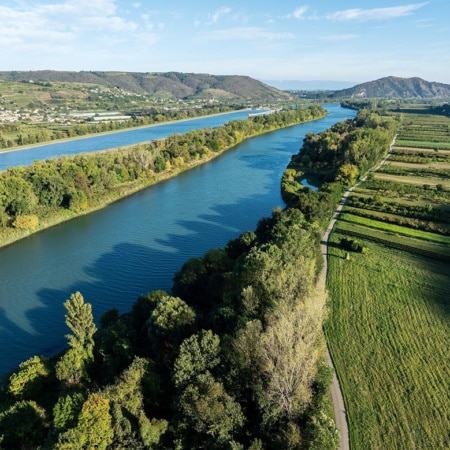
Emblematic works south of Lyon and in Ardèche
Since January 2025, CNR has carried out major restoration works on the banks of the Rhone at the junction of the municipalities of Irigny, Vernaison and Feyzin to refill the second ary branches of the river with water, and recreate wetlands propitious for biodiversity.
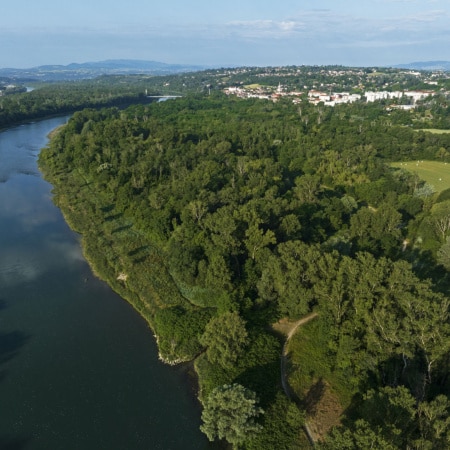
More than 4 kilometres of rockfill and spur dikes built in the 19th century were removed to free the alluvial banks where gravel and silt had accumulated over the years.
The operation should end in 2028 to permit the return of water to 5 kilometres of oxbows and secondary branches, as well as create 6 islets and nearly 8 hectares of ponds and wetlands.
It is one of the largest operations of this type undertaken by CNR on the Rhone since the launching of its ecological restoration programme.
A second very large site started at the beginning of 2026 for a scheduled duration of 6 years on the Rhone at Vion and Chambon in Ardeche (slightly upstream of Tournon-sur-Rhône): 2.4 km of dikes removed, 2 km of oxbows reopened including a branch with a width varying between 50 and 80 m and a project for an aquatic reedbed of 6 hectares!
This restoration will complete other works performed between 2020 and 2027 on the Rhone at Baix, further downstream.
The ecological restoration operations already carried out, in progress or to come on the Rhone
