
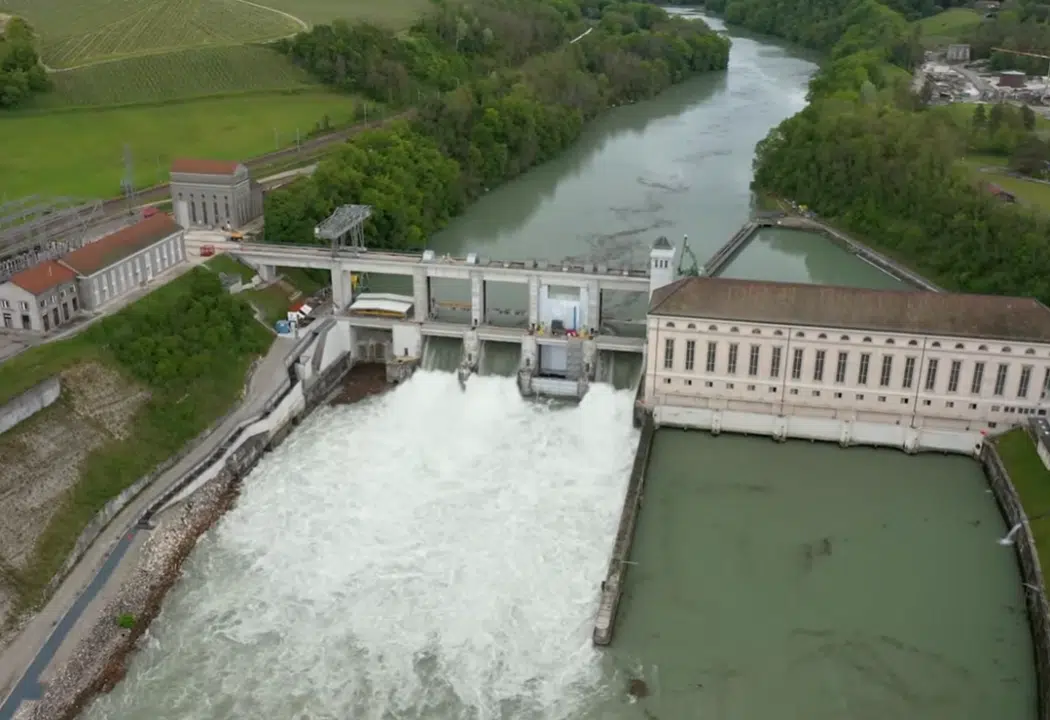
Origin, key dates and descriptions
CNR’s foundations were laid by two visionary politicians: Léon Perrier, member of parliament then senator and President of the General Council of Isère between 1910 and 1940, and Édouard Herriot, mayor of Lyon, senator, member of parliament for the Rhone, Minister and President of the Chamber of Deputies. Both were convinced of the potential of hydroelectricity, and forged a unique model of concession in the service of developing their territory.
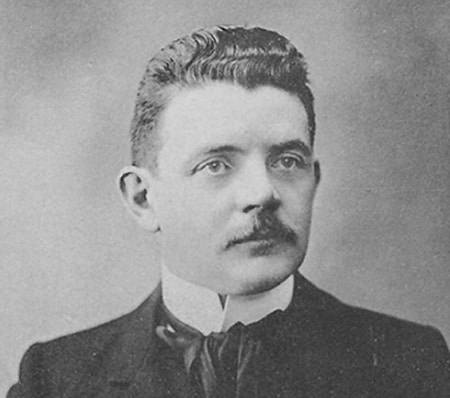
Léon Perrier
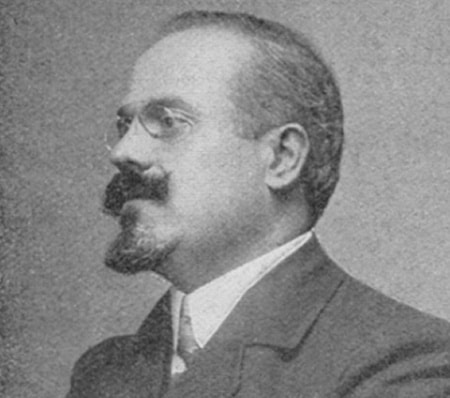
Édouard Herriot
Léon Perrier invented the CNR model: he proposed to entrust the development of the Rhone to a single executive body of which the local authorities were to be both shareholders and stakeholders. As for Édouard Herriot, he drew up the organisation of CNR’s development: using the sale of hydroelectricity to finance the developments required for navigation and irrigation along the Rhone. Thus, the Compagnie Nationale du Rhône and its 3 missions for the community were born.
Since 1935, CNR’s history has been that of the pioneers of carbon-free energy, the men and women who have helped it to grow, and who have passed on and preserved a unique industrial heritage from generation to generation.
CNR by key dates
The Compagnie Nationale du Rhône was founded in the framework of the Rhone law, which structured the river’s development, promulgated in 1921 and implemented in 1931.

The concession of the Rhone was granted to CNR by the State for 75 years. The concession encompasses the development and exploitation of the river and obliged CNR to perform 3 missions for the community: hydroelectricity production, navigation and irrigation.


At the time, it was called the “French Niagara”: the widest and longest dam in Europe.

After the Génissiat dam, CNR inaugurated the hydropower plat of Bollène in 1958. CNR’s hydroelectricity production was transferred to EDF during this period. The development of the Rhone and the construction of the structures along it remained the mission of CNR, which built 19 production facilities and 14 locks between 1958 and 1986. As early as the 1950s, CNR was committed to preserving biodiversity along the Rhone, building the first fish pass at Donzère (1954) and starting a programme of hydraulic and ecological restoration, the only one of its type in the world, in 1998.
CNR went back to being an independent hydroelectricity producer, and integrated its public-private shareholding with the entry into its capital of Electrabel, a subsidiary of the Suez Group, in 2003.

From 2003, CNR diversified in wind and solar power. During the same period, CNR intensified its research and innovations, focusing in particular on hydrogen, electric mobility, and intermittent energy management. General Interest Missions were created with the 8th amendment annexed to the concession specifications in 2003.

A programme in the service of developing the territories of the Rhone Valley structured by way of five-year plans, it organises the redistribution of part of the wealth generated from hydroelectricity production to the territories. The Missions in the General Interest would later become the 5Rhône Plans.

This plans and performs the production of CNR’s 19 hydropower plants along 500km of the Rhone. The guarantor of hydraulic safety, the RMC ensures seamless coordination between the plants and provides a real-time vision of the river’s discharge, thereby making it possible to adapt production.

The aim was to define and implement a programme of sustainable development along the Rhone and the Saone, in collaboration with the different stakeholders in the territory.

This structure is dedicated to facilitating and securing river transport on the Rhone. Active 24/7 and located at Châteauneuf du Rhône, the NMC ensures constant surveillance along the entire navigable length of the Rhone, informs users of traffic in real-time and permits faster lock passages for optimum service quality.

Acquisition of Vol VER, specialised in the development of renewable wind and solar power assets, which has since been rebaptised Vensolair and become a 100% owned subsidiary of CNR.

This subsidiary 100% owned by CNR is specialised in developing solar power projects. CNR exceeded 4,000 MW of installed capacity.

The “Rhone Development” law was adopted unanimously by the French parliament, thus prolonging the concession of the river to CNR until 2041, and providing a framework for the 5Rhône Plans. In line with the Missions in the General Interest, the 5Rhône Plans provide CNR’s technical and financial support to hydropower, navigation, irrigation, environmental protection and biodiversity projects.