4 directions of research and innovation for the territories
Its experience in developing large scale hydroelectric structures, solar power plants and wind farms, and its integrated engineering enables CNR to structure its Research, Innovation and Development (RID) in four major directions. Together, they make up the road map of innovation in the service of energy transition.
Hydropower plant management
This involves improving maintenance and safety, upgrading equipment and optimising hydroelectricity production on the Rhone to strengthen the reliability of the energy system while ensuring the sustainable management of the river.
New renewable energies and associated services
The deployment of innovative solutions such as linear and floating solar power plants, new generation land-based wind power, energy storage, renewable hydrogen for industrial uses and mobility, and controlling energy demand so as to offer efficient solutions for industrial companies and local authorities.
Energy and biodiversity
Innovation at CNR systematically integrates ecological concerns: studies of fish migrations, sediment management and movement, the preservation and restoration of natural habitats, research into the cumulated effects of energy infrastructures, to harmonise renewable energy production with the stainable protection of the Rhone’s ecosystems.
Innovative methods for forecasting, and exploiting renewable energies
The development of tools to improve forecasting and exploiting renewable energies, advanced meteorological models, optimisation algorithms, real-time control systems, in the service of more reliable renewable energy, better foreseen and better integrated in the network.
Innovation, a collaborative and open approach
Partnerships to make energy innovation progress
CNR relies on solid partnerships with major actors in the world of research and education, such as INSA Lyon, EM Lyon, the CEA and its partner laboratories.
Based on constant dialogue between academic research and operational needs, these collaborations lead to the development of key projects encompassing the monitoring of hydropower plants, green and territorial marketing, as well as innovative solutions for producing and managing renewable energy, storage and optimised consumption.
By pooling scientific expertise and practical challenges, CNR strengthens its capacity to innovate in the service of both industry and local authorities in the territories of the Rhone Valley.
Innov’Action: internal competition to stimulate innovation within CNR
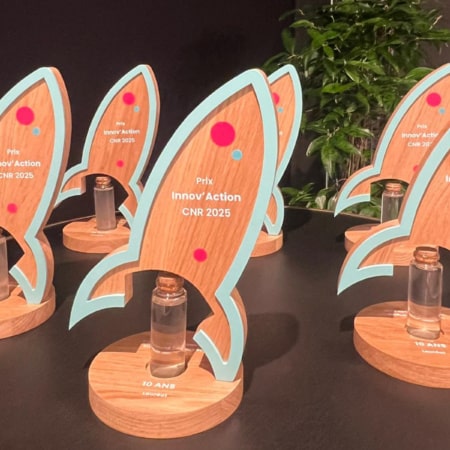
Every year, CNR organises Innov’Action to promote the innovative ideas of its employees. This in-house competition encourages the emergence of new renewable energy solutions, projects for optimising hydroelectricity production on the Rhone and approaches relating to the river’s sustainable management.
Innov’Action has created real enthusiasm and attracts around fifty candidates every year. The projects are evaluated by a jury composed of CNR’s Management Board and partners, then assisted for deployment on the scale of the company. The energy generated by the competition strengthens innovation in the service of the territories, local authorities and industrial companies.
CNR, a committed actor in the “Ruche Industrielle”
Since 2024, CNR has been an active member of the “Ruche Industrielle” (Industrial Hive), a group gathering 19 major actors in the industrial sector. Installed at the heart of Greater Lyon, it is a collaborative movement aimed at accelerating the transition of industry towards a model that is more sustainable, efficient, attractive and connected with its territory.
The “Ruche Industrielle” and its partners also act to change the image of industry, make known the trades involved, the challenges, the major transformations in progress, and to make industry more likeable.
The Chaire Medelia to prolong the life of hydraulic structures
Since 2023, CNR has been a partner and sponsor of the Chaire Medelia of the Fondation Grenoble INP. The aim is to study the probabilistic fatigue of the steel structures of hydraulic installations, to improve their durability, safety and maintenance.
Alongside EDF, Artelia, Spretec, Tec21 and CETIM, this partnership enables exploring new scientific techniques to predict the ageing of structures and optimise interventions.
Zoom on our research projects and experiments!
Osmotic energy: a promising path
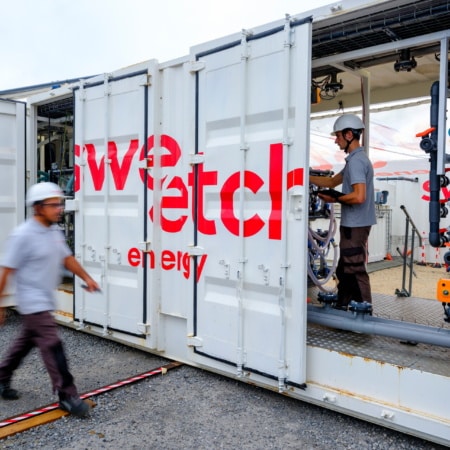
Osmotic energy entails exploring electricity production based on the differences in salinity between two media and is a promising new path for producing renewable electricity. CNR is studying this potential with Sweetch Energy, thanks to INOD®, an innovative technology. A pilot site will be launched in the Rhone delta to test this solution in real conditions.
In the long-term osmotic energy could supply as much as 4 TWh/year, making it a source in synergy with solar, wind and hydro-power in the French energy mix.
Ophélia: the ViaRhôna becomes solar
At Caderousse, an original demonstrator transforms 4 km of the ViaRhôna cycle track into an energy infrastructure. A total of 6 photovoltaic canopies 110 m long, installed at a height of 5 m, are intended to produce renewable electricity without requiring additional land.
This innovative project, carried out with Nexans, Schneider Electric, SNCF, SuperGrid Institute and the Department of Vaucluse, is aimed at demonstrating the feasibility of a linear photovoltaic system that can be replicated on a large number of infrastructures elsewhere in France.
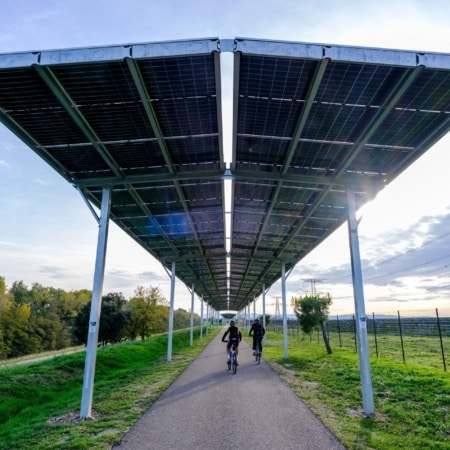
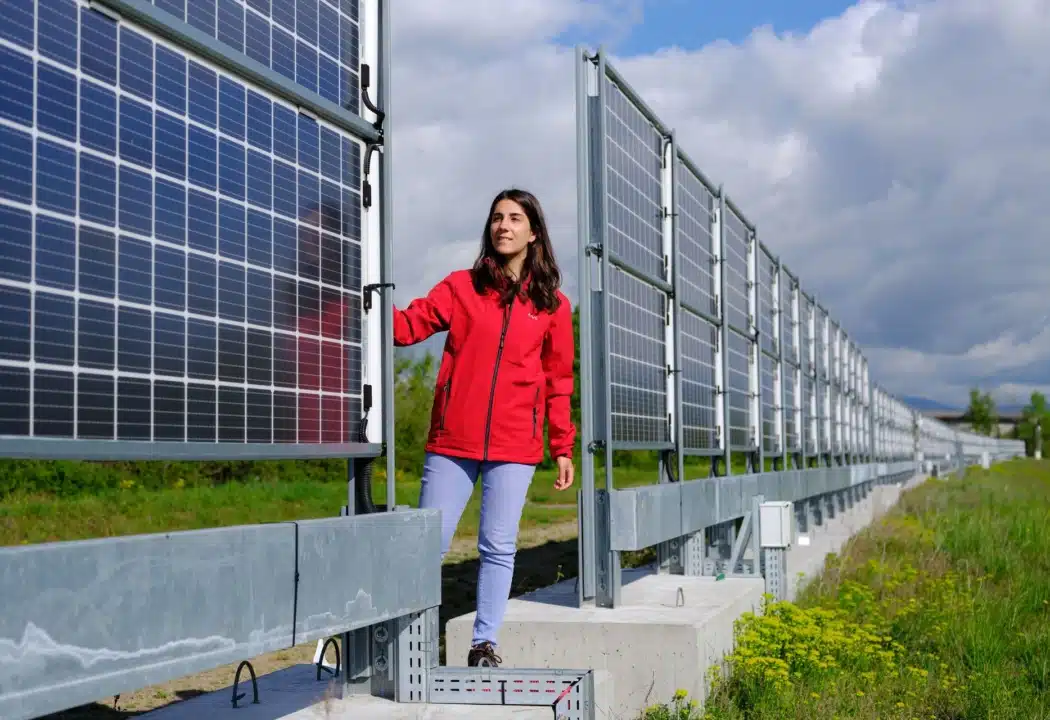
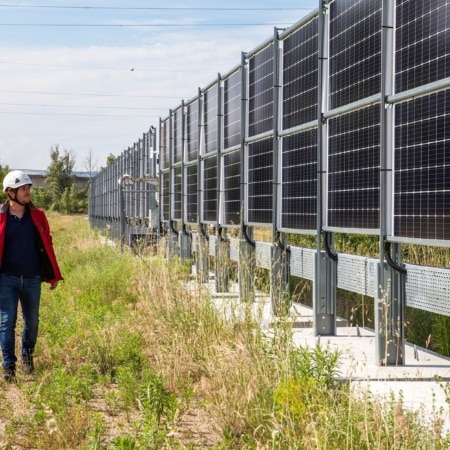
The demonstrator of Sablons: a first for linear, vertical, bifacial PV systems
In a situation in which France must considerably increase its photovoltaic capacity from now to 2050, linear photovoltaic systems are aimed at exploiting already developed spaces without conflicting with other uses.
This solution consists in installing solar panels on very long and narrow strips of land, such as dikes, roads, railways and noise barriers. The panels are installed vertically, directed east-west, and are capable of capturing solar radiation on both faces. Contrary to traditional installations tilted southwards, this configuration makes it possible to produce electricity both in the morning and the afternoon, by avoiding a peak concentrated at midday.
The project at Sablons (Isère) is the first experiment by CNR using this technology.
Ô Solaire / Madone Lake: the first floating solar power plant
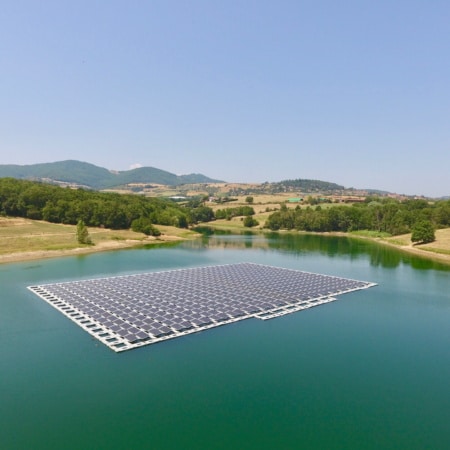
The project combines solar electricity production, agricultural irrigation and aquatic biodiversity preservation. It is installed on Madone lake, a hill reservoir located at the junction of the municipalities of Mornant and Chabanière (Rhône), historically intended for agricultural irrigation and now shared by numerous leisure and environmental uses.
Ô SOLAIRE consists of a floating solar power plant with an installed capacity of 230 kWp, covering only 4% of the reservoir, i.e. about 2,500 m². This solution produces renewable electricity without artificializing new agricultural or natural land, thereby responding to a major challenge of territorial acceptability. Annual production is estimated at 250 MWh, which corresponds to the annual electricity consumption of three irrigation pumps of the lake or about 57 households, while avoiding the emission of 36 tons of CO₂ a year.
Fields of the future: agrivoltaics as a solution of the future
The Fields of the Future programme explores the potential of agrivoltaics as a solution for reconciling agricultural production and solar energy. At Dardilly, in the Rhone, CNR is testing two systems: a mobile photovoltaic canopy above strawberry and raspberry crops, and another covering a horticulture nursery.
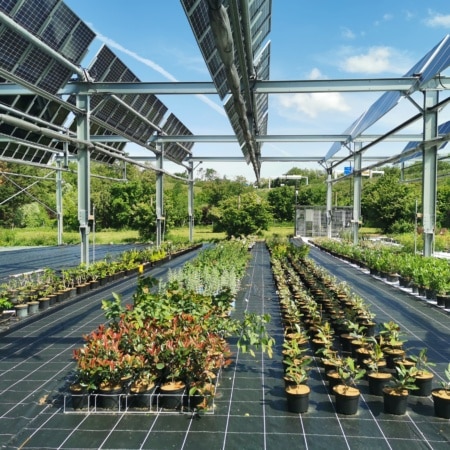
These installations create a protective microclimate that reduces hydric stress, heat and climate hazards, all while generating renewable electricity. The aim is to demonstrate that the same space can produce energy, increase agricultural resilience and avoid artificializing land, in a model that can be replicated elsewhere in the territories.
This dynamic agrivoltaics project is being carried out alongside the Auvergne-Rhone Alps Region and the EPLEFPA (Local Public Education and Professional Agricultural Training Establishment) Lyon Dardilly-Ecully.
The Energies Quay: a station for recharging with 100% renewable energies
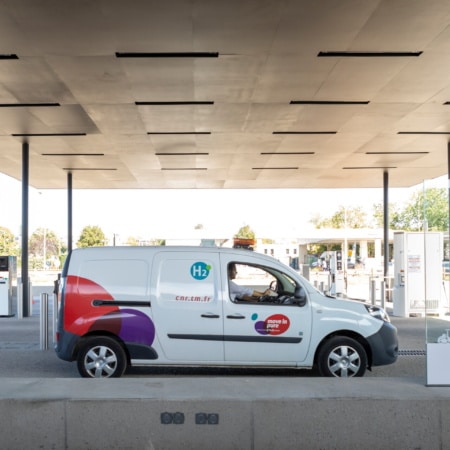
In 2020, CNR inaugurated an original recharging station that provides 3 types of renewable energy: renewable hydrogen, green electricity and bio CNG (compressed natural gas).
And what is more: green electricity is available in fast and ultra-fast charging (100 km in 4 minutes)!