
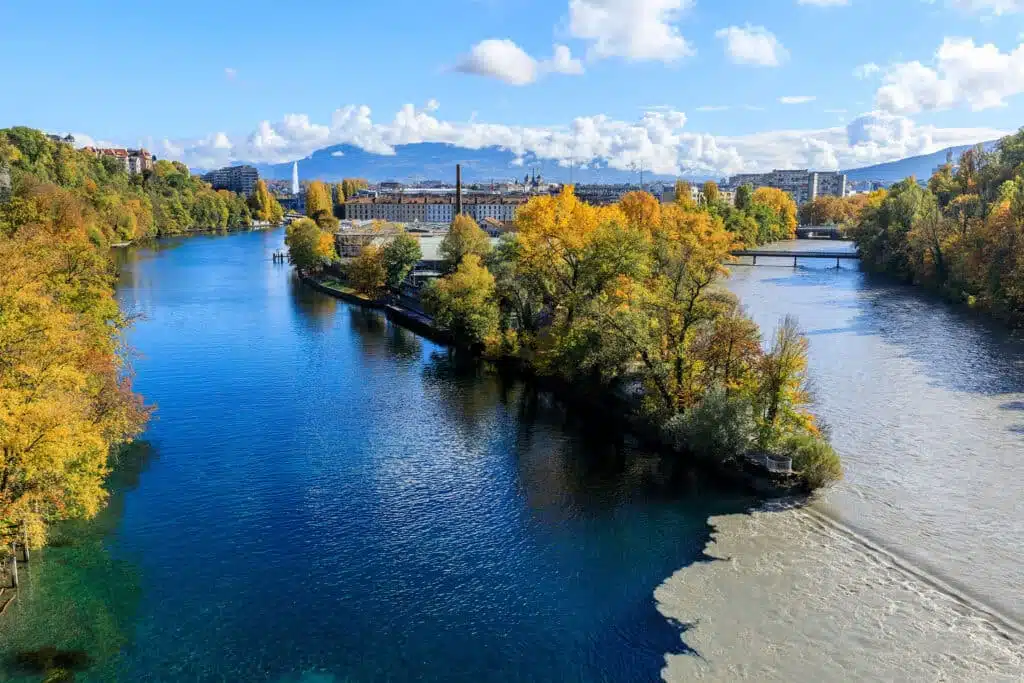
Mixed and concerted management of the Rhone’s sediments
To prevent risks of flooding in the low-laying quarters of Geneva, the Services Industriels de Genève (SIG) had to monitor the level of sediments (clay, silt, snd, etc.) that accumulate over time at the foot of dams.
The main operation takes place every 3 or 4 years. It entails the partial lowering of the forebay of the hydropower dam of Verbois. Carried out by SIG, it includes measures taken by the operator of the dam of Chancy-Pougny and CNR. The aim of this French-Swiss management is to get as much of the sediments to transit (within the limit of 1.5 million m3) to the Mediterranean Sea while preserving the environment and the biodiversity of the river.
What is sediment management?
It entails operations such as dredging, releases of water, etc. to ensure that the quantity of sediments present in a river remains compatible with the environment (impacts on the fauna and flora, etc.).
CNR takes care of the river and its environment
CNR uses exceptional human and technical resources to carry out this operation efficiently. CNR acts in close cooperation with the Services industriels de Genève (SIG), and under the control of the Swiss and French administrative authorities, in compliance with several inter-prefectural rulings.
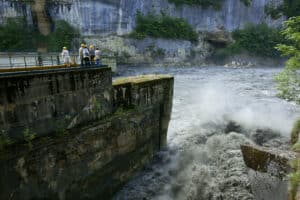
In parallel with lowering the forebays of the Swiss dams, CNR almost simultaneously begins progressively lowering the level of its six forebays located between Génissiat and Sault-Brénaz, with specific lowering operation intended to maintain water quality compatible with fish life and biodiversity.
These operations are carried out to increase water flow velocity to ensure the transfer of the sediments.

Limiting the impacts: CNR’s priority
CNR organises a series of technical and visual monitoring procedures and adopts environmental measures to lessen the effects of the sediment management operations on aquatic habitats.
These monitoring activities are performed jointly with the French and Swiss authorities, local anglers (angling associations, AAPPMA, professional fishers) and CNR’s partners (Rhone Sediment Observatory, nature consultancies, environmental associations, etc.).
Controlling suspended matter (SM)
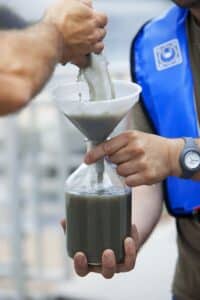
Throughout the operations and 24/7, CNR monitors the turbidity of the water at a series of sampling points and measurement sites distributed along the Upper Rhone. The aim is to avoid exceeding the maximum suspended matter values defined beforehand by the authorities. Aquatic fauna can be affected if the particle concentrations are too high.
Monitoring water quality and evaluating the quality of microplastics in the sediments
Besides the rate of suspended matter, CNR works with the INRAE and ENTPE to evaluate the quantities of microplastics in the sediments. It also controls other water quality indicators in close collaboration with scientific experts such as temperature, pH, toxicology, oxygen rate, ammonia rate, bacteriology, and so forth.
Preserving the bypassed sections of the Rhone
The natural sections of the Rhone of Chautagne, Belley and Brégnier-Cordon have undergone major restoration and ecological works. To preserve these areas rich in biodiversity, CNR maintains a reduced level of compensation water at these dams to preserve aquatic species.
So, what will you see during this period?
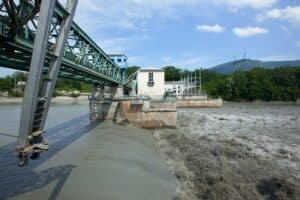
The river will have a different aspect during this operation. The presence of suspended matter leads to a change in colour and aspect of the water. It becomes darker, between brown and grey.
An unusual odour may emanate from the river in some places. Do not worry, the river will return to its usual aspect shortly after the end of the operations!
You should be aware that safety instructions must be complied with during the operations:
- Navigation, bathing and all other nautical activities are forbidden by inter-prefectural ruling concerning the Rhone between the Swiss border and downstream of the hydroelectricity development of Sault-Brénaz.
- Fishing is also forbidden in the bypassed sections of the Rhone of the hydropower plants of Chautagne, Belley, and Brégnier-Cordon from the dam of Champagneux (73) up to the confluence with the river Gland at Saint-Benoît (01).
- Access to dry parts is also forbidden.
I also remind you of the usual safety instructions: it is dangerous to venture onto the bed of the Rhone, on the islets and gravel banks, even if the level of the water is low.
The operations can be interrupted at any time in the case of flooding, exceeding the threshold in the rate of suspended matter or an incident in a hydropower plant.
The water can rise very quickly. Beware!


Sediment management operation on the Upper Rhône 2025 – Presentation Duration :3:51 min
Do you have any questions? Contact us!
"*" indicates required fields