
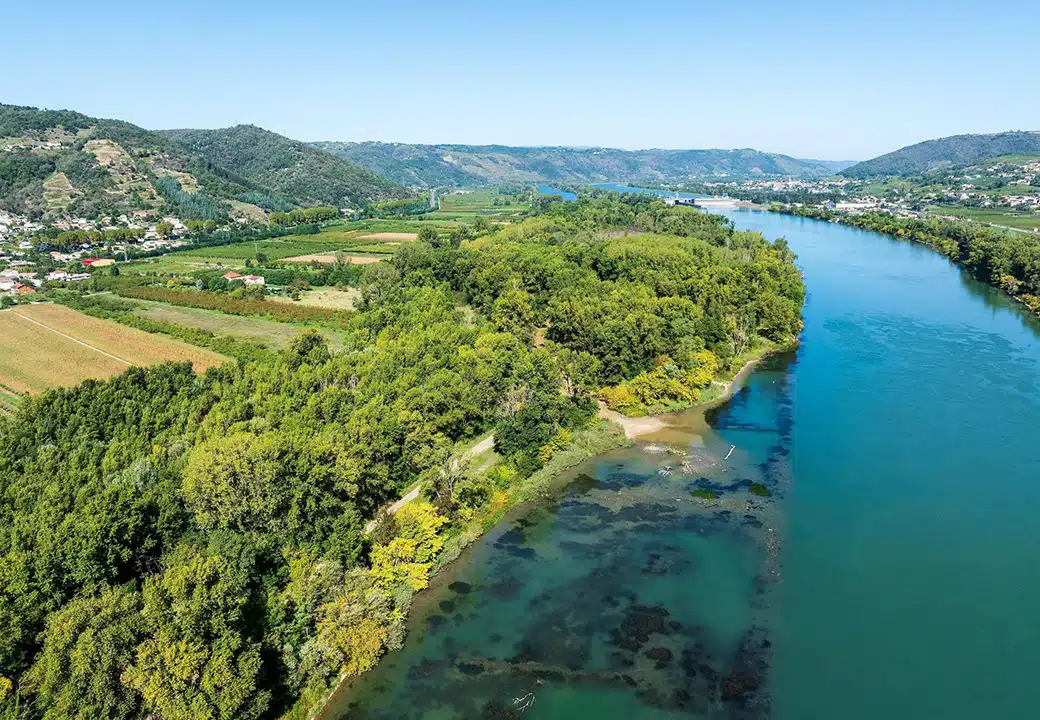

The goals targeted
- Return the Rhone to more natural functioning with more space to evolve and with sediment transport partially restored.
- Favour biodiversity, by re-establishing habitats favourable for a large number of species, including certain rare or protected ones.
- Increase the positive effects of floods, especially in the oxbows, thereby favouring “self-maintenance” to limit clogging by sediments, and allow erosion processes that diversify ecosystems.
- Prepare the river’s resilience to climate change, by favouring exchanges between all the aquatic habitats composing it: main channel, secondary branches, wetlands, underground aquifers, etc.
The actions carried out
- Remove the Girardon spur dikes.
- Excavate the beds of former oxbows and new secondary branches.
- Return to the river fines and coarse materials taken from earthworks leading to the return of sediment continuity and restoring the river bed.
- Plant varied and adapted species (black and white poplars, white willows, etc.) to combat colonisation by invasive species.

The works accomplished
Spur dikes of Vion and the oxbow of Lemps:
- Dismantling of the Girardon structures (2.4 km of dikes; 63,000 m3 of rockfill removed and recycled).
- Excavation of secondary branches (2 km).
- Creation of islets (7).
- Reinforcement of the riparian forests and combat against invasive species.
Wetland of Saint-Estève:
- Excavation and development of a wetland (6 ha).
- Plantation of an aquatic reedbed.


In all, more than 180,000 m³ of sediments will be reintroduced into the Rhone, including 40,000 m³ of gravel from the spur dikes of Vion. On the sites of Lemps and Saint-Estève, the historic gravel embankments (580,000 m³), resulting from the construction of the hydroelectric development of Gervans in 1971, are not planned to be restored to the Rhone. They will be removed by river and recycled via the circular economy.
The calendar
The earthworks will take place from September to February over several years, to limit impacts on the biological cycles of plant and animal species as well on as the use of the site for leisure purposes.
- Vion: from September 2025 to February 2029
- Lemps: from September 2025 to February 2030
- Saint-Estève: from September 2029 to February 2033
A project designed in concert
For 20 years, the global project of the ecological restoration of the Rhone has been carried out in parallel by a scientific research programme, RhônEco, that above all performs ecological monitoring. Regular dialogue with CNR makes it possible to adapt actions according to feedback from the field and check the efficiency of the measures taken.
Extensive consultation was carried out with the territories, river users, (walkers, anglers, cyclists, hunters, canoeists, etc), the neighbouring population, nature associations, scientists, and institutional and financial actors such as the State, the Rhone-Mediterranean-Corsica Water Agency and the European Union. Different visits to sites and workshops led to the shared conception of this project of proven utility.
With the support of partners:


Newsletter
If you would like to receive news about this project, you can subscribe to CNR’s newsletter by writing to restauration-rhone@cnr.tm.fr
This email address is used only for the transmission of newsletters and managing subscriptions to it.
You can withdraw your consent to this data processing at any time, and can exercise your rights by writing to the following address: donnees.personnelles@cnr.tm.fr
Know more about the management of your data and your rights