Vertical linear bifacial photovoltaics
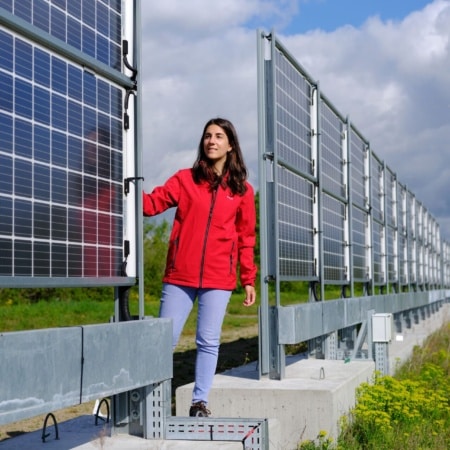
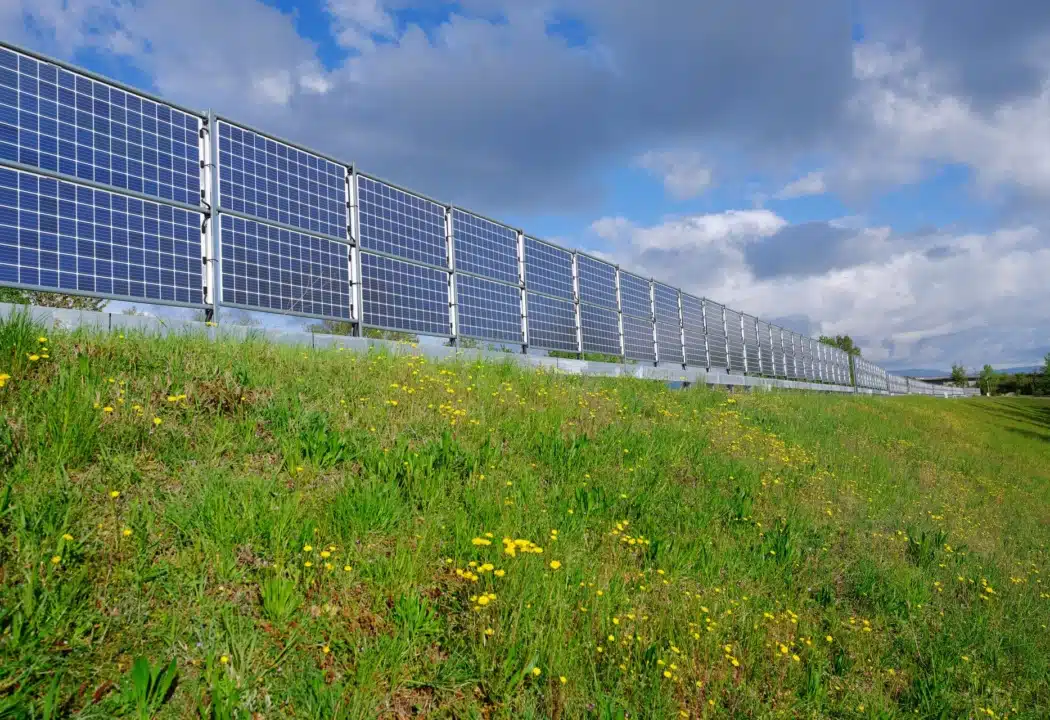
Linear photovoltaics consists in installing solar power plants on very long narrow plots like dikes and roads. The particularity of bifacial, vertical solar panels is that they can be installed vertically along a line rather than being tilted, for example in successive rows as in most cases for ground-based plants or on roofs.
The panels used are bifacial, that is to say they can absorb solar radiation on both sides, on the front and rear of the panel. Thus, by orienting these panels east-west they capture sunlight in the morning and the afternoon.
Its advantages
- Electricity production is distributed over a longer time period more in phase with the needs of consumers;
- The solar energy produced is better integrated in the electricity network by avoiding production peaks at midday.
The Sablons demonstrator
The winner in 2018 of a call for solar power offers from the Energy Regulation Commission (CRE) in the category “innovative photovoltaic technologies” to encourage innovative solar technologies, CNR’s linear photovoltaic demonstrator at Sablons is the 1st linear photovoltaic demonstrator installed on a dike in France.
This innovative technology permits accelerating the integration of solar power in the territories, while avoiding conflicts of use for the exploitation of long plots already used.
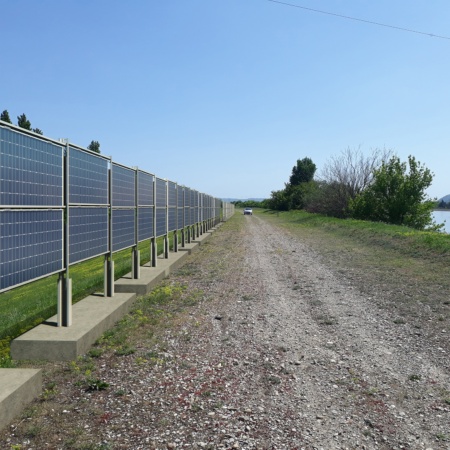
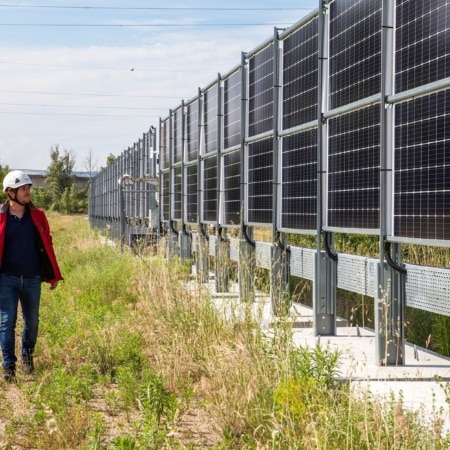
The scheme allows testing 288 bifacial panels placed vertically side-by-side to form a linear surface along 350 metres. With a height of 3.40 metres in 2 rows, these panels, more durable and waterproof than those in classical ground-based plants, also allow producing electricity over a longer time period better adapted to the needs of the territories and those who live in them.
Its annual production of 104 kWp corresponds to the electricity and heating consumption of about 50 households, while avoiding the emission of nearly 77 tons of CO₂ a year.
This demonstrator can be accessed directly by the user of the dike on the Rhone. The plant is not enclosed and the panels can be approached close up, thus making it possible to test the reconciliation of uses in the field.
The objectives
- To study its advantage and technical-economic feasibility, in particular its compatibility with the dikes before considering deployment on a larger scale along the river. The structure could be adapted for an installation along highways, railways and other bases (noise barriers, enclosure walls).
- To exploit land already used while preserving other uses.
- To increase awareness of the general public by allowing them to see the panels in operation close up, and thus increase their societal acceptance.
- To participate in increasing the installed capacity of solar power in France.
A development integrated in its environment
- The safety function of the dike compatible with using a non-intrusive anchoring solution (concrete bollards).
- The project is compatible with operating constraints due to its reduced occupation of land and regular spacing along the installation.
- The architecture of the construction avoids any contact with conductive parts (connection cables protected and inaccessible).
- Panel supports using concrete joists placed on the ground, spaced apart to allow the passage of fauna under the rows of panels.
- The users of the dikes along the Rhone will be invited express their comments on this non-enclosed solar power plant in order to assess their acceptance of this new technology.
Initial feedback
The Sablons demonstrator developed with the CEA was first tested in the laboratory and on a test bench with panels from different suppliers, making it possible to:
- Verify the performance ratio of the rear face of the panel in relation to that of the front face. A panel with a high bi-faciality coefficient will have better performances.
- Measure the influence of reflection on the soil for the production of the panels.
- Evaluate the impact of the panel connection cable junction boxes and the frames supporting the panels providing shade.
INES 2S is carrying out other studies on the performances of the installation during its first years of operation.