
Dynamic agrivoltaics
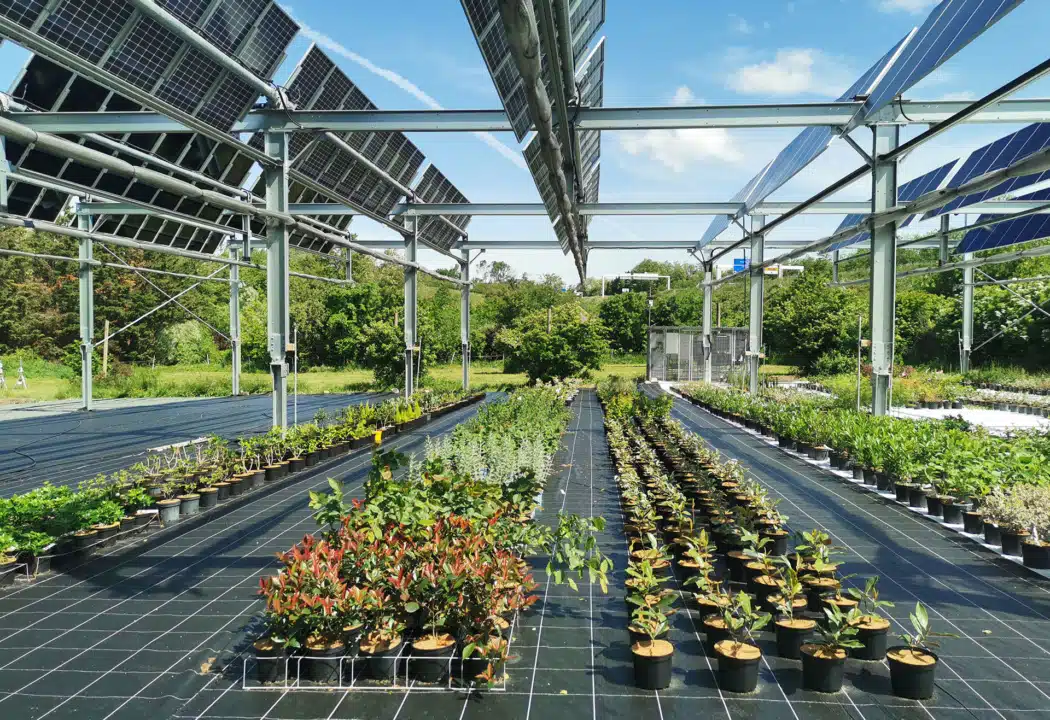
Agrivoltaics consists in installing photovoltaic panels on a field of a farm where they will contribute lastingly to the installation, maintenance and development of agricultural production. It is dynamic when the shade provided by the panels can be controlled according to the needs of the plants.
The orientation of these panels is controlled by algorithms and data collected by sensors that measure light, temperature, hygrometry and the state of the plants’ hydric health.
Whatever the case, priority is given to the needs of the plants, with renewable electricity production taking second place.
Experimentation at Dardilly
Begun during the Rhone Challenge of 2018 in which CNR and the Auvergne-Rhône-Alpes Region voted to launch a local demonstrator for innovative irrigation and energy technologies in the service of agriculture, the aims of this agrivoltaics experiment are to:
- Manage water resources sustainably;
- Favour the adaptation of farm crops to climate change;
- Harness the production of renewable electricity;
- Provide feedback to the sector and professionals.
This aim of this demonstrator is also to test and validate the model’s technical-economic viability, and consider its replication in other farms.
This project has been funded through the 5Rhône Plans and represents a total investment of €1 million, 40% of which was provided by the Auvergne-Rhône-Alpes Region.
Two experimental sites
The “Fields of the Future” project studies the behaviour of the same crop on two fields of the same surface area, one equipped with photovoltaic canopies and the other without, called control field.
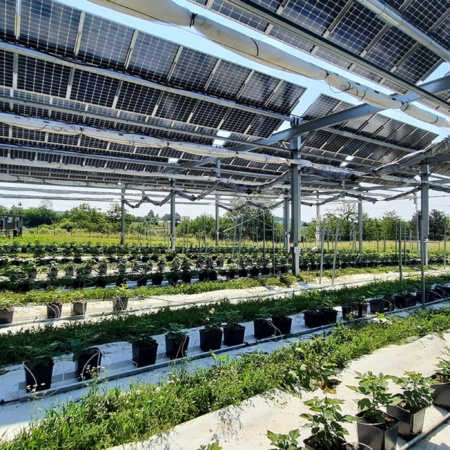
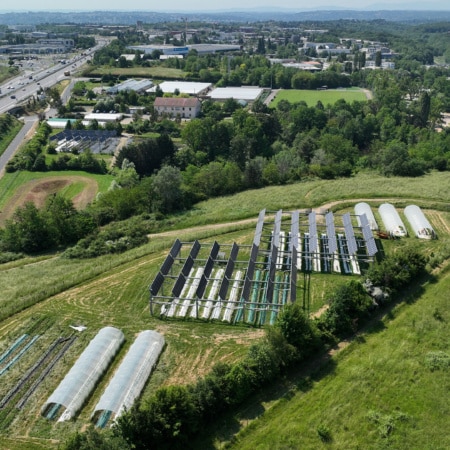
At the beginning of 2023, 504 mobile photovoltaic panels were installed at a height of 5 metres above two fields, with a total power of 230 kWp.
The site of Colline
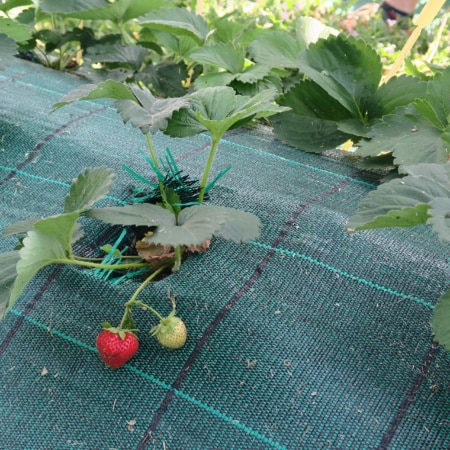
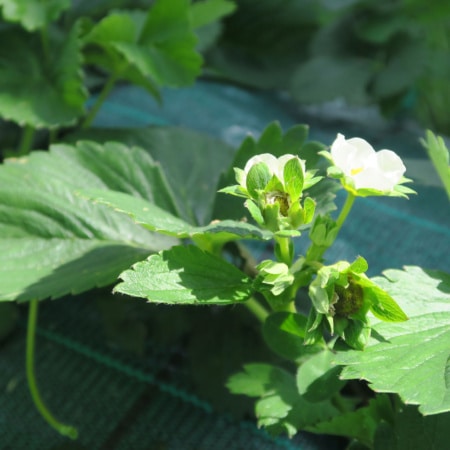
The site of Colline is intended for growing strawberries using organic farming and raspberries using traditional farming methods. It covers an area of 3,000 m²:
- 1,500 m² under canopies equipped with bifacial photovoltaic panels, i.e. which receive both the direct rays of the sun and rays reflected by the ground;
- 1,500 m² of control plots under a tunnel greenhouse and agroforestry (plantation of kakis providing shade) for the strawberries and under the tunnel greenhouse for the raspberries.
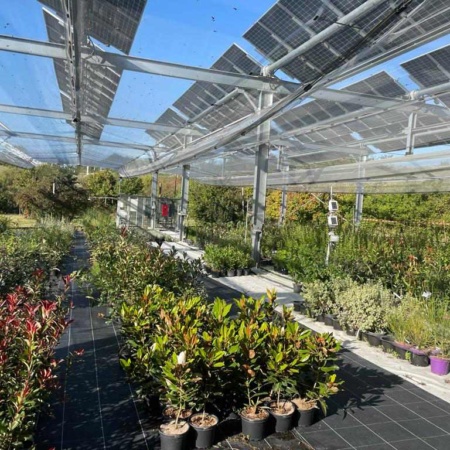
Soilless nursery
The site of the nursery is intended for growing ornamental plants. It has a surface area of 1,500 m²:
- 750 m² under canopies equipped with bifacial photovoltaic panels,
- 750 m² of non-covered control fields.
The soil is covered by black or white tarpaulins to study the impact on the behaviour of plants and on electricity production of the difference in albedo*.
*Albedo: the physical value that indicates the quantity of incident sunlight reflected by a surface.
The advantages for plants
These experiments are aimed at showing that managing a field shaded by controlled photovoltaic panels installed above crops can:
- Protect crops against climatic hazards (frost, hail);
- Control temperatures and sunlight;
- Support protection nets (hail protection, anti-insect, rain shelters);
- Secure and perpetuate yields while improving product quality;
- Reduce the water consumption of plants by limiting their evapotranspiration using the shade provided by the panels.
Promising results
The experiment, lasting 3 years, will continue until 2026. When it ends, the data collected and analysed should allow offering professionals in the agricultural sector a viable and replicable technical-economic system.
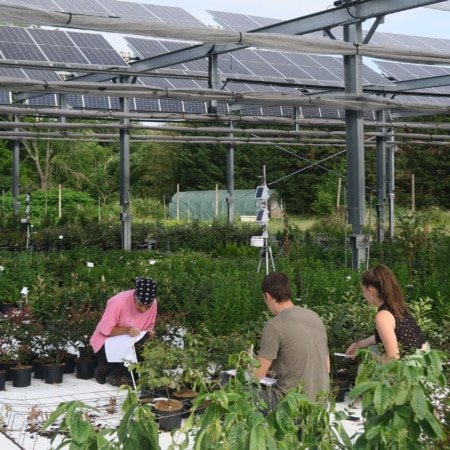
When comparing the crops that benefited from agronomic control to those located in the control field (open air or plastic tunnel), the first results analysed by experts are encouraging:
- Regarding the microclimate, extreme temperatures and humidity are smoothed, limiting root damage, for example;
- Regarding irrigation, water consumption is considerably reduced;
- Regarding fruits, their quality is maintained and even improved; the results on yields depend on the climate of the year.
The partners involved
To carry out its projects, CNR gathers partners with acknowledged expertise. The Fields of the Future experiment therefore benefits from the experience and skills of key actors.
Project funders and instigators
- CNR: instigator of the project, investor, aggregator of partners and energy manager;
- The Auvergne-Rhône-Alpes Region: owner of the fields and joint funder of the project;
- The Campus Agrilyon Vert of Lyon-Dardilly-Ecully: technicians and agricultural instructors responsible for growing and selling the crops, and transmitting the knowledge acquired.
Bodies providing expertise
- SUN’AGRI: expert and controller of the tool used to modulate the shading provided to the crops;
- OMEXOM EnR Lyon, subsidiary of Vinci Energies: expert in designing and building photovoltaic power plants;
- INES laboratory of the CEA: expert in innovative photovoltaic modules, design and study of innovative modules and technical monitoring of solar radiation and electricity production.
Assistance and scientific and professional validation
- ASTREDHOR Auvergne-Rhône-Alpes: agronomic monitoring of the nursery field.
- CTIFL (Centre Technique Interprofession des Fruits et Légumes): agronomic monitoring of the Colline field.
- Chambre d’Agriculture du Rhône: assistance to the Campus Agrilyon Vert in carrying out the agricultural work on the Colline site.