
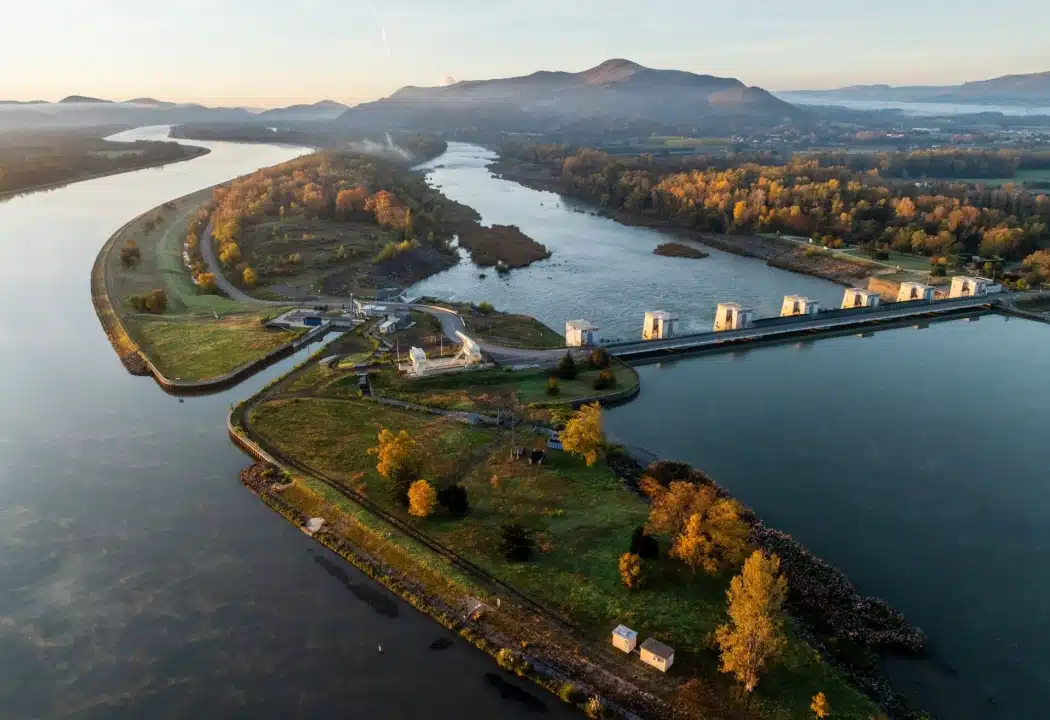
The six new small hydropower plants (SHPP) will be installed (from upstream to downstream at Saint-Pierre de Bœuf, Arras, La Roche de Glun, Charmes sur Rhône, Donzère and Caderousse. By exploiting the compensation water feeding the bypassed sections of the Rhone, they will allow increasing hydroelectricity production by more than 253 GWh/an, corresponding to the consumption of more than 110,000 inhabitants.
A fish pass will be installed at each site to restore continuity for the river’s fish, essential for migrating species and biodiversity.
These investments of more than €200 M extend the works already carried out successfully on the dams of Pierre Bénite (2000), Motz (2012), Lavours (2014), Rochemaure (2015), Pouzin (2017), Sauveterre (2018) and Vallabrègues (2026).
CNR ensures reconciling energy performance and ecological restoration
SHPP: renewable production adjacent to the river
Small hydropower plants use the driving force and the discharge of the Rhone to produce renewable and carbon free energy. Built alongside the existing dams, they are located at the confluence between the navigable canal and the bypassed section of the Rhone: part of the discharge intended for the natural branch is therefore harnessed by turbines and then restored to the river.
These structures have been designed to respond to the energy needs of the territories while reducing their environmental footprint. Their architecture is adapted to local constraints, the configuration of the dams and existing uses. Furthermore, they will participate in securing sustainable energy supplies.
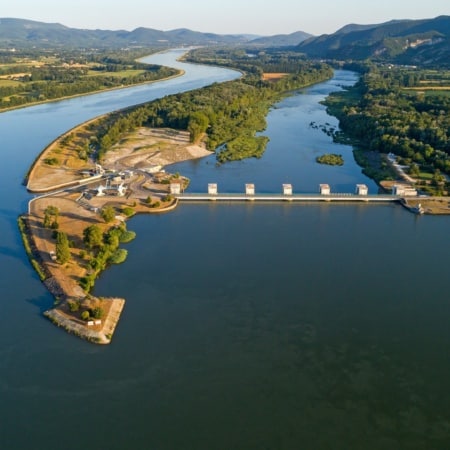
Restoring fish continuity with fish passes
The fish passes associated with the SHPP make up a large part of the programme. They permit fish species — in particular major migrating species such as lamprey, eel and shad — to bypass the dams.
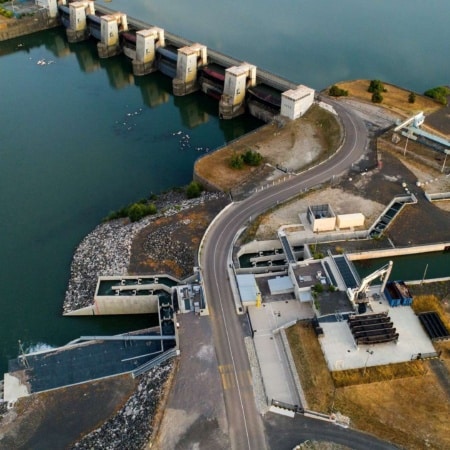
These structures take the form of a water stairway composed of several tens of successive basins. Hydraulic attraction of several m³/s guides the fish to the entrance of the pass and aids their passage upstream. Each fish pass is designed to also allow the passage of fish downstream, thus ensuring the reconstitution of biological cycles.
These developments enable CNR to continue work begun several decades ago to reconnect the natural habitats of the Rhone and favour the return of different species.
A structural investment programme for the territory
Zoom on the SHPP of Caderousse
The small hydropower plant of Caderousse will supply a power of about 7,000 kW, generated by two Kaplan hydroelectric turbine units 2.9 m in diameter. The system will allow a discharge of 74.5 m³/s, through the turbines for an estimated annual output of 45 GWh, i.e. the equivalent consumption of 20,000 inhabitants.
The fish pass linked to it will have a difference in level of 9 metres and 55 steps of 17 cm, allowing the passage of long-distance migrating species as well as about forty other species in the sector, in particular the Rhone streber.
The installation on the left bank, in conformity with the regulations, immediately adjacent to the dam of Caderousse, ensures circulation during the works and minimises local constraints.
This project has a budget of €45 M and will require 4 years of works, from 2026 to 2030, including:
- excavation and laying the foundations of the structures,
- civil engineering,
- assembling the hydroelectric turbine units,
- connection with the ENEDIS network,
- the test phase up to commissioning.
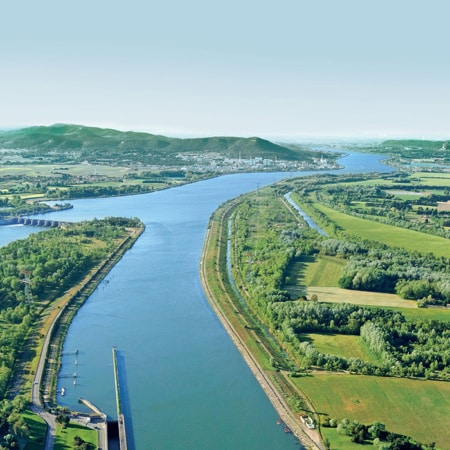
Zoom on the SHPP of Donzère
The small hydropower plant of Donzère will develop about 8,200 kW of hydroelectricity using two Kaplan hydropower turbines of 3.1 metres in diameter. The installation will allow a discharge of 100 m³/s through the turbines to produce 44 GWh/year, i.e. the equivalent electricity consumption of more than 20,000 inhabitants.
A fish pass with a difference in level of 8.2 metres and 55 steps of 15 cm will allow the passage of long-distance migrating species as well as about forty other species to swim up the Rhone.
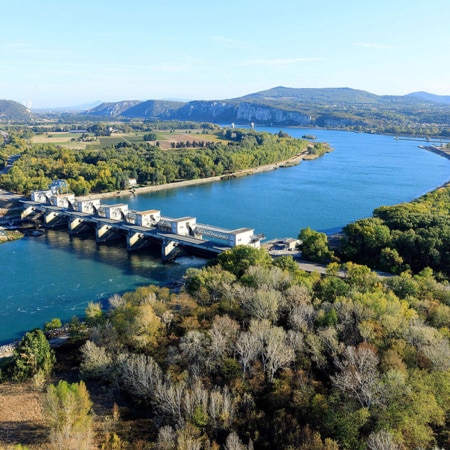
The installation on the left bank has been chosen to reduce the number of constraints on the departmental road RD 93 and reduce its impact on the environment.
The budget estimated for the project amounts to €52 M for 5 years of works (2027–2032) including:
- excavation and laying the foundations of the structures,
- the diversion of the RD 93,
- carrying out civil engineering,
- the installation of the hydroelectric turbine units,
- connection to the ENEDIS network and commissioning.