
Sales contact: +33 (0)4 78 61 60 00
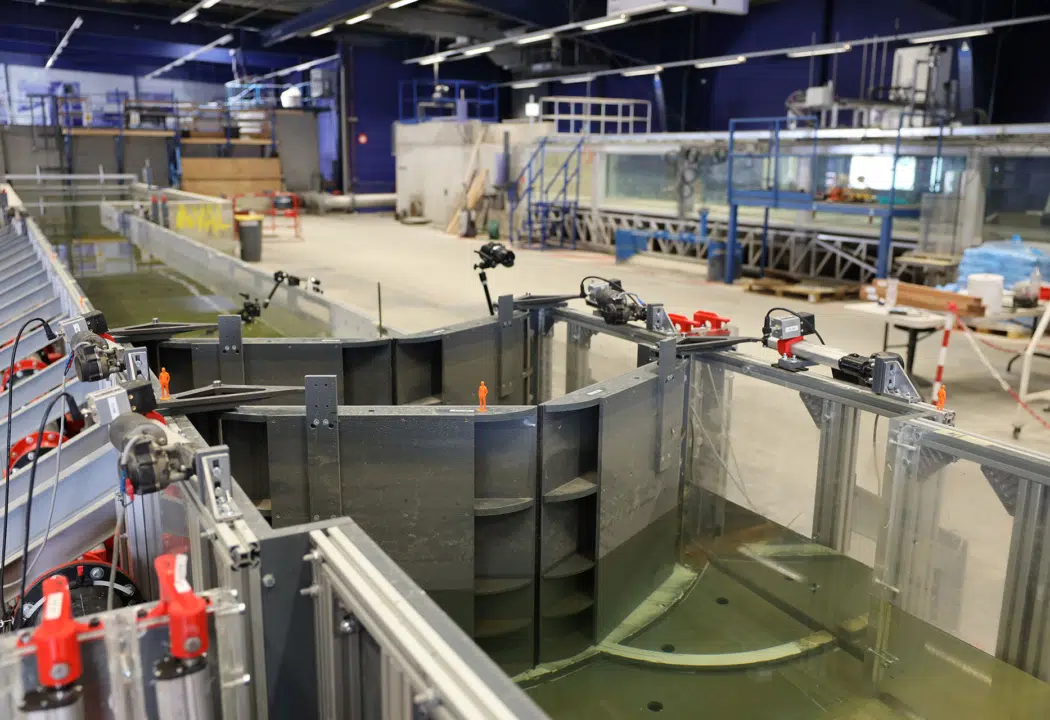
The scope of action of CNR’s hydraulics laboratory quickly expanded to other territories and problems so that all project owners and developers could benefit from CNR’s unrivalled technical experience in order to efficiently optimise the performance of hydraulic developments in the planning stage, especially regarding:
- Dimensioning,
- Hydraulic operation,
- Long-term hydrodynamic and sedimentation impacts,
- Construction conditions,
- Construction and operating costs.
What is a physical hydraulic model?
A physical hydraulic model is a tool that enables studying a section of river or designing a hydraulic structure using a physical mock-up built at a smaller scale. Physical hydraulic modelling relies on the law of similarities that allow reproducing, at scale, flow and solid transport conditions within a natural system and ensure the representation of the dominant forces governing the movement of water and sediments according to appropriate proportions.

The laboratory covers a vast scope of hydraulic studies and services
The expertise of CNR’s applied hydraulics laboratory covers the following areas of study:
- Hydroelectric projects: water intakes, headrace canals and dikes, galleries and shafts with pressure flows, hydroelectric plants, performance measurements on sites, etc.;
- Dams and reservoirs: flood spillways, bottom outlets, regulating gates, impact basins, energy dissipation structures, silting of reservoirs, etc;
- River developments: weirs, structures spanning river valleys, trash traps, flood protection dikes, fish passes, etc.;
- Hydromorphology: sediment continuity, river morphodynamics, ecological restoration of rivers;
- Erosion and sedimentation: sediment traps, bridge piers, rockfill, groynes;
- Torrential hydraulics: bedload deposits, pipework, torrential hazard, natural dams;
- Navigation structures: canals, locks, navigable waterways, regulation structures;
- Urban hydraulics: water intakes, drop structures, storm spillways, pumping stations, complex drainage systems.


A hydraulics laboratory expert in physical hydraulic modelling and hybrid modelling
A physical hydraulic model is a competitive and reliable tool for optimising the performance and cost of complex structures as well as for modelling sediment transport in rivers and torrents efficiently. Physical hydraulic models are used to test a very wide range of technical solutions and explore extreme scenarios without risk. They are also highly efficient communication and consultation tools for assisting decision-makers when making technical-economic choices.
Despite the increase in the technical capacities of mathematical modelling, physical hydraulic models remain indispensable tools when designing a hydraulic development in which complex flows occur or which may have an impact on hydrodynamics and sediments difficult to foresee in the long-term.
Far from being antagonistic, physical hydraulic and numerical models are now used in complete synergy and are well-adapted for joint use when simulating the most difficult hydro-sedimentary problems. In this case we speak of hybrid modelling.

What is a hybrid model?
Hybrid modelling consists in coupling a physical model with one or more numerical models to optimise the quality of the results, the duration and the cost of a study by filling in the weak point of a model with the strong points of another. This type of modelling above all allows extending the area occupied by a sector modelled by nesting models and/scales, evaluating and correcting certain effects of scales, and carrying out a cross-check of the results.

Optimize your hydraulic project using physical and hybrid modeling tools Duration :3:29 min
A hydraulics laboratory endowed with leading edge test and measurement equipment
The physical hydraulics models designed by the team at CNR’s hydraulics laboratory use test and measurement equipment that range from standard devices to the very latest technologies in the domain:
- Constant level pumping station and distribution system supplying models with a discharge up to 700 l/s;
- Electromagnetic flowmeters;
- Data acquisition system (levels, pressures, velocities, discharges, efforts, etc.) in real-time;
- Natural and artificial materials used to adequately reproduce very different sediment situations in solid transport studies,
- Ultrasound and high frequency pressure sensors for measuring levels;
- Laser velocimetry, PIV (Particle Image Velocimetry), LSPIV (Large Scale Particle Image Velocimetry),
- Acoustic Doppler Velocimetry to measure the velocity of water without disturbing its flow,
- Automatic systems for surveying submerged and immerged beds: ultrasonic echosounders, laser tacheometers, photogrammetry in and out of water, etc.
Contact the CESAME

Visit to CESAME by 3rd year students from the Ecole Centrale de Lyon Duration :1:57 min
Key figures
3 000 m²
total surface area of test hall
700 l/s
supply capacity
2 circuits
independent pumping
1 glass flume
large capacity
1 platform
modulable hydro-sedimentation
1 workshop
multi-materials shaping