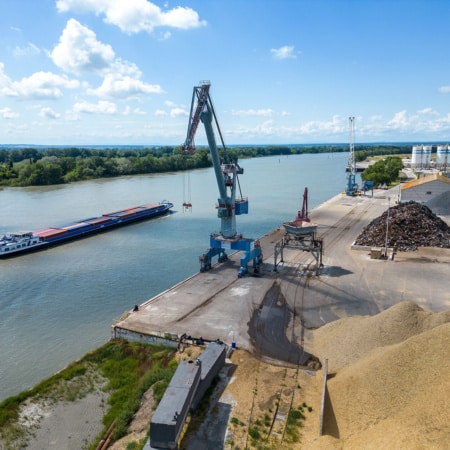
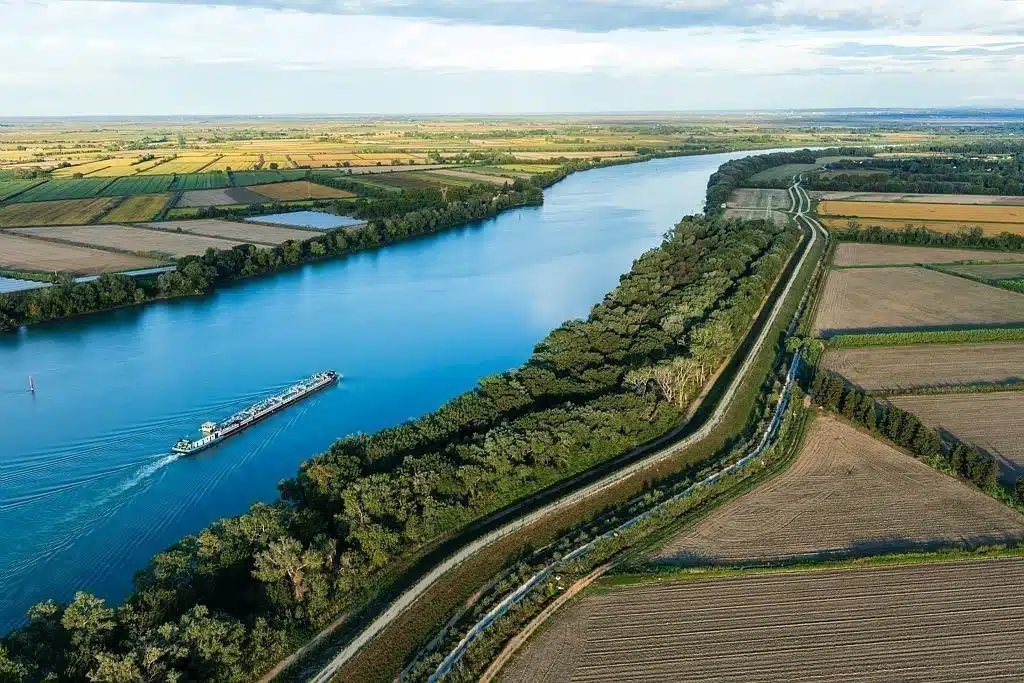
The backbone of south-east France, the MeRS corridor links the ports of Marseille-Fos, Sète and Toulon to the major economic and industrial hubs of the Rhone Valley and the Soane, serving four large regions and a catchment area with a population of 21 million.
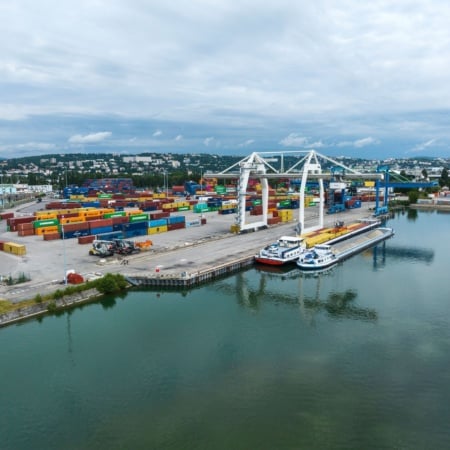
With its port infrastructures, railway links and strategic supply of property, the MeRS corridor provides still greatly unexploited potential in a situation of saturated road infrastructures and the requirement to reduce CO₂ emissions.
This ambition is now materialised with the active involvement of the CNU (unified national collective) alongside the State, Port de Marseille-Fos, local authorities, and all the business and industrial actors, based on shared governance and operational projects.
CNR, a driver of development along the MeRS corridor
As the historic developer of the Rhone and manager of 330 kilometres of navigable wide-gauge waterway, CNR plays a structural role in developing the MeRS corridor.
At present, 75% of river traffic on the MeRS corridor transits via the port and industrial sites operated by CNR, illustrating its pivotal role in the corridor’s logistic organisation.
CNR deploys an operational strategy in the service of modal transfer and the massification of flows. In the framework of the 5Rhône Plan, CNR has launched nearly 70 projects since 2022, investing €22.5 million to improve the reliability, safety and capacity of the navigation structures, improve the quality of services for skippers and optimise the supervision of flows between maritime and inland ports.
The recent renewal of several port sub-concessions – Lyon, Salaise/Sablons, Portes-lès-Valence, Arles – henceforth integrates these goals of environmental performance and the massification of logistic transport. Thus, more than €80 million of public-private investment, including €14 million funded by CNR, have been made available to upgrade the logistic infrastructures and ports of the Rhone.
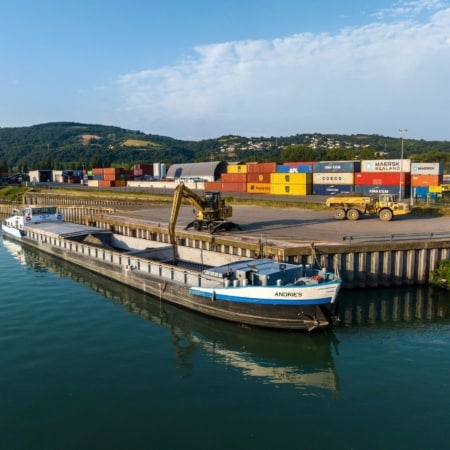
Via Medlink Ports, the agency tasked with promoting multimodal transfer and the decarbonation of goods traffic along the MeRS corridor, CNR is also involved alongside all the actors to dynamize river and rail transport, and spur new solutions.
Ôrizon 2035: a collective road map for the Rhone-Soane river corridor
The master river corridor plan, Ôrizon 2035, is a strategic reference framework for river development on the Rhone–Saone corridor. Stemming from wide-ranging consultation bringing together the State, VNF, CNR, the local authorities and more than 120 public and private actors, it sets out a shared vision and operational action plan until 2035.
Ôrizon 2035 is based on a central principle: the option of balance and ambition. It permits the development of the entire basin, by taking into account the specific characteristics of each territory, while combining the stakes of local activities with those of opening up to international markets. The plan also aims to strengthen the integration of river and port governance, organise a mesh of specialised and synergetic ports, and upgrade infrastructures and services.
This road map is structured around major strategic directions, transformed into concrete actions to win over river freight, aid the growth of river tourism and make the river a major lever for ecological transition.
The success of the MeRS corridor relies on efficient and balanced governance adapted to the diversity of the territories. Since 2021, at the initiative of the government, the Inter-port and Logistics Coordination Council (CCIL) organises a dynamic partnership between all the actors: the government, infrastructure managers, local authorities, Chambers of Commerce and Industry and economic operators.
This collective work has led to concrete progress: the adoption of a corridor master plan, the compilation of a common property catalogue, reflection on reforming handling costs to favour modal transfer, improving customs coordination and developing innovative projects.
In 2025, this impetus resulted in on-lining an interactive map accessible to all: South MeRS Corridor. This innovative initiative to digitise the entire supply chain, allows identifying the key actors of bulk transport and logistics (companies, infrastructures and services) on the MeRS corridor, thus improving the transparency, clarity and coordination of flows.
Continuing the works begun by the CCIL, CNR and Port de Marseille-Fos work to organise stronger cooperation to utilise land for business and logistics purposes, with the capacity of purchasing, developing and selling new industrial and port sites. This approach is intended to simplify interfaces, speed up decision-making and facilitate the implementation of projects stemming from the CCIL.
The goal is clear: offer regional and national companies easier access to land, efficient logistics solutions and better links from the hinterland to Mediterranean ports and European markets.