
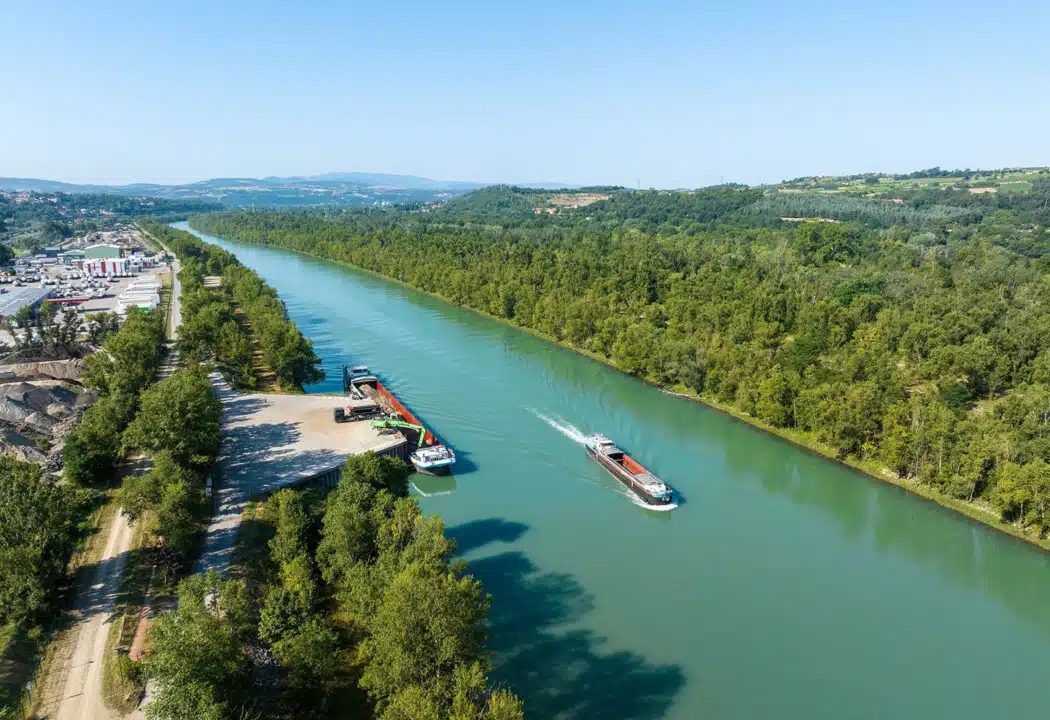
The ports of the Rhone: a structural logistics network
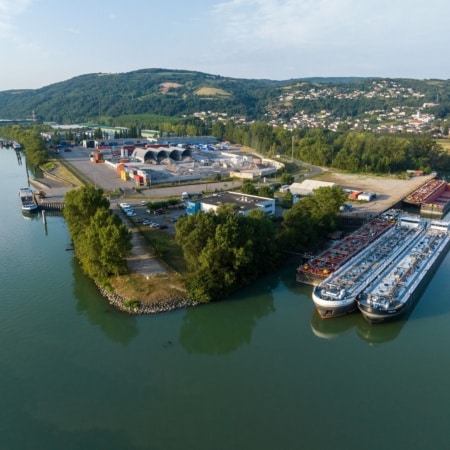
CNR manages 17 industrial and port sites situated along the river.
These platforms represent authentic multimodal hubs, linking the river with rail and road networks, and providing companies solutions adapted to their varying needs. At present, 75% of river traffic on the river on the MeRS corridor transits via the platforms managed by CNR.
The ports of the Rhone encompass about 928 hectares of port and industrial activities, with serviced plots, river wharves, warehouses, railway branch lines, and road connections. This diversity of infrastructures allows businesses to choose tailored multimodal logistics, facilitating massified flows and reducing the carbon footprint of transport.
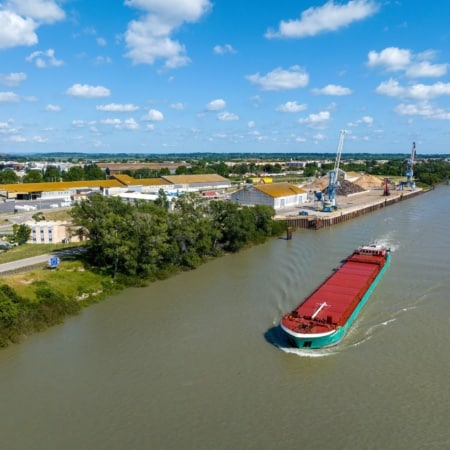
In 2024 and 2025, the renewal of the sub-concessions of the ports of Lyon, Vienne Sud, Portes-lès-Valence and Arles made it possible to incorporate ambitious massification and environmental performance goals.
This dynamism fulfils the ambitions of the MeRS corridor to increase the modal share of the river while supporting the reindustrialisation and economic attractiveness of the territories.
Port de Lyon, a leading multimodal hub
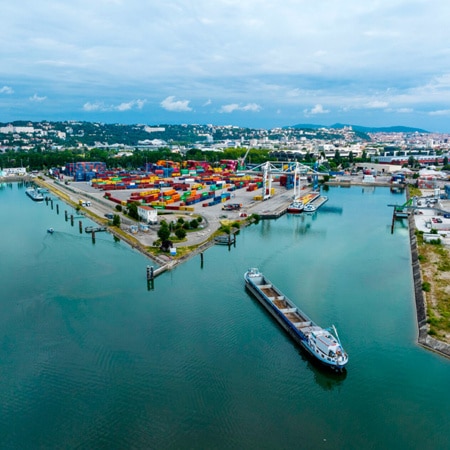
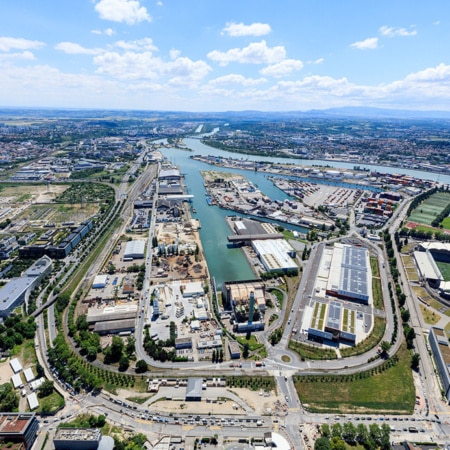
A genuine logistics gateway into greater Lyon, Port de Lyon has two container terminals, 9 km of riverside including 2.2 km of straight wharves, and 22 km of railway. Thus, it combines river, rail, road, river-maritime transport and an oil pipeline, providing users with rare logistics flexibility. 70 companies are currently installed in the enterprise zone.
In December 2024, CNR entrusted the sub-concession of its two container terminals for 30 years to Lyon Rhône Terminal, a consortium led by CMA CGM, combining the Banque des Territoires, the CCI de Lyon and the CCI d’Aix-Marseille-Provence.
By relying on the expertise of a global actor in maritime and logistics solutions, CNR intends to give new impetus to container traffic on the MeRS corridor, strengthening continuity with the terminals at Marseille and optimising the operation of the existing terminals.
An ambitious goal has been set of 100,000 river containers and 80,000 rail containers a year by 2030, enabled by an investment programme amounting to €40 million.
The Urban Logistics Hotel: a model of integrated logistics
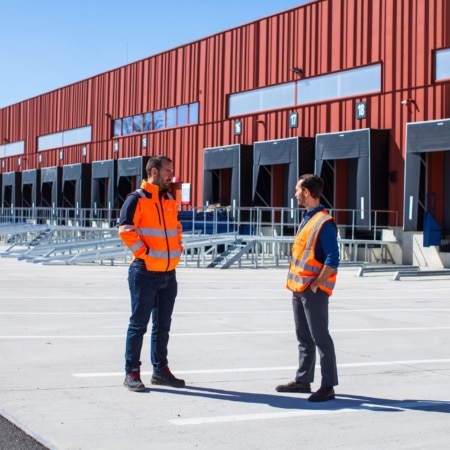
The inauguration of the Urban Logistics Hotel at the heart of Port de Lyon in 2024, highlights the evolution of logistics methods. The aim is to massify flows entering greater Lyon, reducing emissions in the Low Emissions Zone (ZFE) and offering carbon-free last-mile delivery solutions.
This investment of €46 million includes 15,000 m² of photovoltaic panels, as well as a biogas, electricity and, eventually, a hydrogen charging centre. It embodies a new generation of logistics centres in the service of a more sustainable city.
Setting-up in the Rhone Valley: a territory of opportunities
Strategic and accessible plots on offer
CNR offers companies serviced and constructible plots along the Rhone: close to 840 hectares have already been allotted, and another 100 hectares are still available.
These plots provide rail and river links allowing companies to control their entire supply chains, from storage to transport.
This facilitated access to land, combined with adapted services, encourages the installation of industrial, logistics and trading companies on the Rhone corridor, contributing to territorial reindustrialisation and activity relocation.
To date, 220 companies have opted to set up in the ports of the Rhone, including Port de Lyon, and benefit from the installations and logistics services offered by CNR.
To accelerate reindustrialisation, the Corridor Master Plan identifies 35 key sites for the installation of industrial and logistics activities, offering a port land catalogue grouping 10,000 hectares and 27 sites of the five port infrastructure managers.
This approach ensures strategic visibility for investors, coherent developments and better exploitation of the river estate.
A propitious environment for business development
For companies, setting up in the Rhone Valley means links between the river, rail, road and sea and quick access to Northern Europe, Mediterranean ports and international markets, all while reducing costs and environmental impacts. They also benefit from the availability of 100% renewable energy produced locally by CNR.
These installations strengthen the industrial attractiveness of the Rhone Valley: the presence of clusters, job creation, relocation of production, development of ecological logistics, and more.
CNR’s industrial and port sites also underpin 18,000 jobs in the Rhone Valley, emphasising the corridor’s economic importance.